Date Published
September 25, 2024
Total Read
4 min
Tags
Have you ever wondered how AI assistants like ChatGPT work and why they sometimes can't answer specific questions about you or your company? In this article, we'll explore the concepts behind Large Language Models (LLMs) and introduce Retrieval-Augmented Generation (RAG), a technique that addresses many of the limitations of traditional LLMs.
LLMs are essentially powerful prediction engines. They take your prompt and generate a response based on the likelihood of what comes next in a sequence of text. In other words, they predict the next word based on all the previous words they have been trained on.
As humans, we interpret these predictions as meaningful answers to our questions. This is because LLMs have been trained on enormous amounts of data—virtually every book ever written and the entire internet. By consuming almost every word in the order it was written, they become extremely skilled at predicting which words follow others.
Despite their impressive capabilities, LLMs have their limitations:
Static Knowledge: LLMs are "frozen in time" and lack up-to-date information. For example, ChatGPT's training data cutoff point was October 2023, meaning it's unaware of events after that date.
Lack of Domain-Specific Knowledge
LLMs are trained for generalized tasks and don't know your company's private data or specific domain information.
Black Box Nature
It's not easy to understand which sources an LLM was considering when arriving at its conclusions.
Inefficiency and Cost
Few organizations have the resources to produce and deploy foundation models.
This means that if you ask an AI assistant about your specific vacation policy at work or details about your personal life, it won't be able to provide an answer. Manually inputting this information every time is both time-consuming and impractical.
Retrieval-Augmented Generation (RAG) is an architecture that provides the most relevant and contextually important proprietary, private, or dynamic data to your Generative AI application's LLM when it is performing tasks. This technique enhances the accuracy and performance of AI systems.
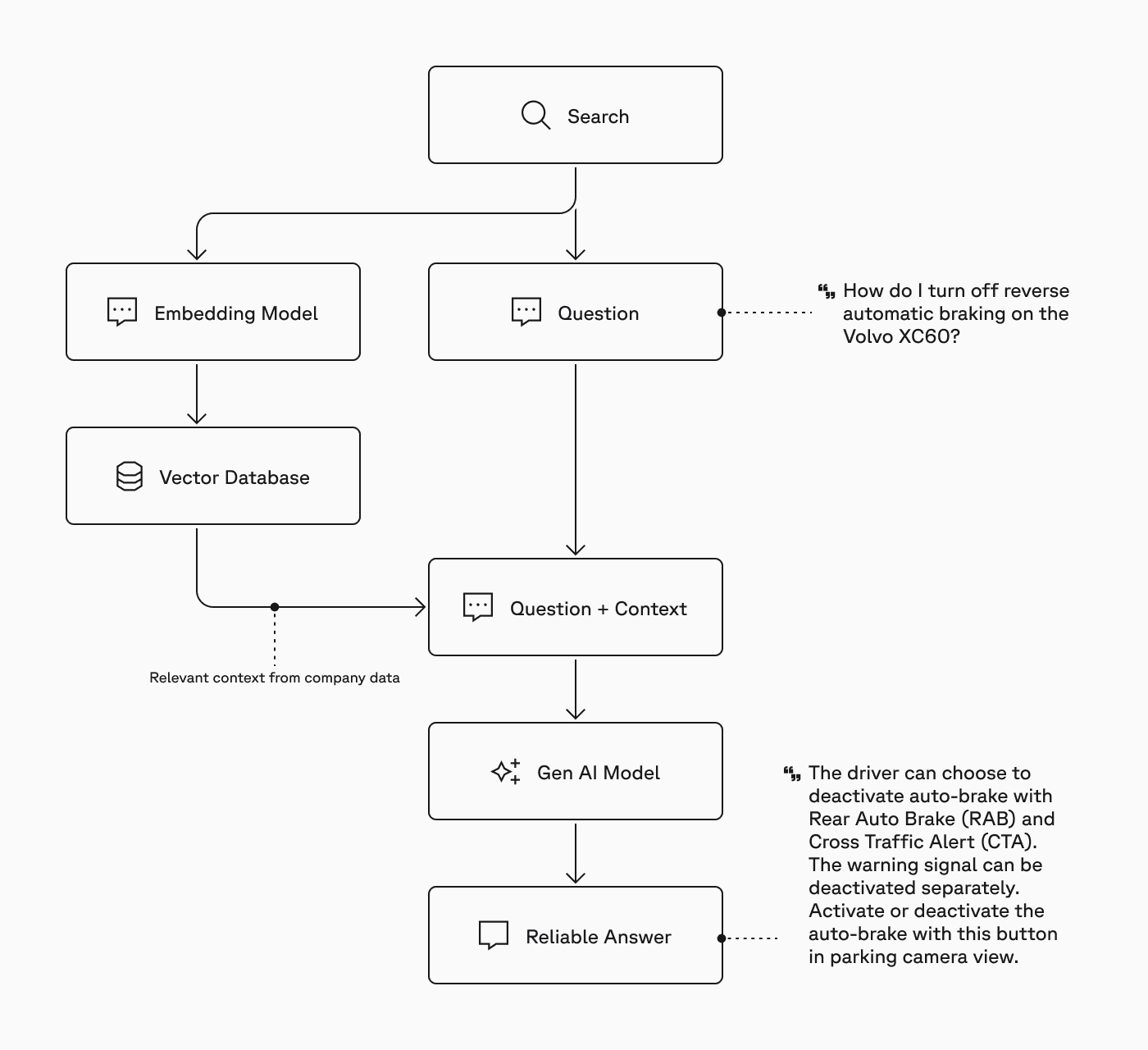
Creating a Vector Database: First, domain-specific proprietary data is converted into vectors using an embedding model. These vectors represent the meaning of the input data.
Storing Vectors: The vectors are stored in a vector database like Pinecone, which can search billions of items for similar matches in under a second.
Query Processing: When a user issues a query, it's converted into embeddings.
Semantic Search: The vector database performs a "nearest neighbor" search to find the most relevant information.
Context Injection: The retrieved information is provided to the LLM through its context window, alongside the original prompt.
Response Generation: The LLM generates a response based on both the original prompt and the additional context.
Up-to-Date Information
RAG can provide the LLM with the most recent data, solving the recency problem.
Domain-Specific Knowledge
It allows the inclusion of proprietary or specialized information not available in the LLM's general training data.
Reduced Hallucinations
By providing grounding facts, RAG reduces the likelihood of the LLM generating false or misleading information.
Improved Auditability
RAG enables GenAI applications to cite their sources, making the process more transparent and easier to audit.
Cost-Effective
Compared to creating or fine-tuning foundation models, RAG is a more accessible and efficient way to improve AI performance.
RAG represents a significant advancement in AI and natural language processing. By combining the broad knowledge of large language models with the ability to retrieve and integrate specific information in real-time, AI assistants become more useful and relevant than ever before. This approach addresses many of the limitations of traditional LLMs, providing more accurate, up-to-date, and context-aware responses.
As we continue to develop and refine these technologies, we can expect AI assistants to become even more capable of handling complex, domain-specific tasks while maintaining their broad general knowledge base.
Do you have experience using AI assistants with RAG technology? Feel free to share your thoughts and questions!